The most common Meta ads account we see from Indian D2C brands has one or two broad campaigns doing everything: finding new customers, chasing cart abandoners, and re-selling to past buyers, all from the same budget. It works until it doesn’t — and when ROAS slips, nobody can tell which part broke.
Here’s the structure we rebuild accounts around, and the order we do it in.
Step 1: Fix the signal before the structure
Meta’s delivery system optimises toward the conversions it can see. If purchases are going missing, every campaign is learning from bad data.
- Run the Pixel and the Conversions API together. The browser Pixel misses events to ad blockers and privacy settings; the Conversions API sends them server-side. On Shopify, the official Facebook & Instagram sales channel sets up both — choose the maximum data-sharing level during setup.
- Check event match quality in Events Manager. Meta scores each event from 0 to 10 based on the customer information sent with it; more accurate parameters mean a higher score and better matching.
- Keep the catalog in sync — prices, stock, and images — so product ads never show something you can’t ship.
Step 2: Separate campaigns by intent
| Campaign | Who it reaches | How it’s built |
|---|---|---|
| Prospecting | People who’ve never engaged with you | An Advantage+ sales campaign, broad targeting, creative-led |
| Retargeting | Site visitors, add-to-cart abandoners, Instagram and Facebook engagers (last 30 days) | A separate manual campaign, excluding recent purchasers |
| Catalog | People who viewed specific products | Dynamic product ads from your catalog |
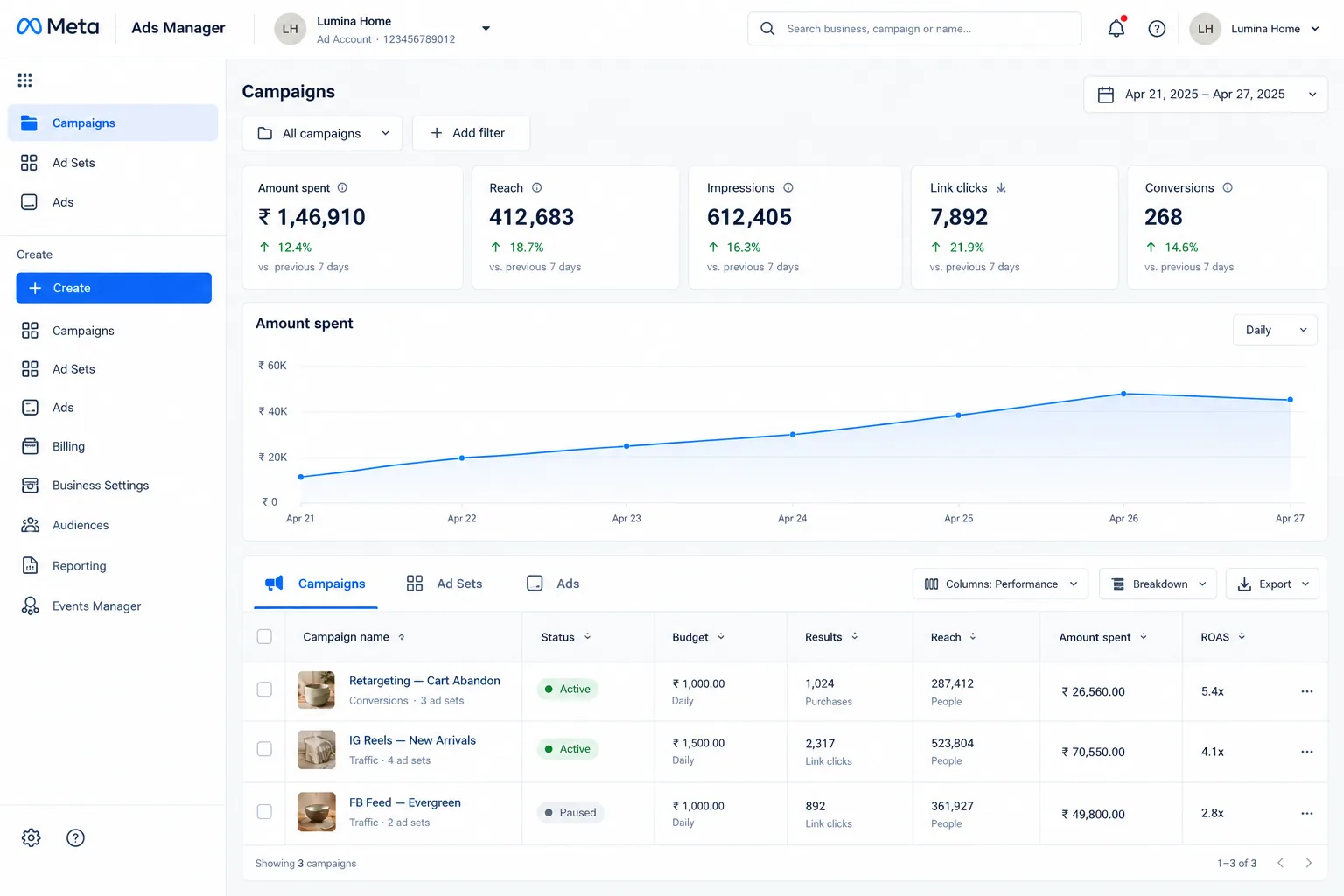
Advantage+ sales campaigns (which replaced Advantage+ shopping campaigns) are good at finding buyers, but left alone they happily spend on people who were about to buy anyway. Keeping retargeting in its own campaign lets you see — and control — what each stage actually costs.
Step 3: Let audience size set the retargeting budget
There’s no magic percentage. Retargeting audiences are small, so overspending just shows the same ad to the same people too often. Budget retargeting so frequency stays reasonable, and put the rest behind prospecting — that’s the part that grows the business.
Step 4: Creative is the targeting
With broad targeting, the ad itself decides who responds. Run three to five variants per campaign across formats — vertical Reels, carousels, and statics — with the hook in the first few seconds. Pause losers on data, give winners budget, and refresh before performance fades rather than after.
Step 5: Measure what the bank account sees
Platform ROAS is a useful signal, not the truth. Two checks keep it honest:
- Blended ROAS — total revenue divided by total ad spend across every platform. If platform ROAS climbs while blended ROAS stays flat, campaigns are claiming credit for sales that would have happened anyway.
- Delivered revenue, not placed orders. Meta counts a purchase when the order is placed. In India, cash-on-delivery orders that are refused never become revenue — so a campaign with heavy RTO can look profitable while losing money.
A weekly routine
- Check event match quality and catalog errors
- Review ROAS by campaign stage, plus blended ROAS and delivered revenue
- Pause losing creative, scale winners, launch the next test
- Check retargeting frequency
- Adjust prospecting budget in small steps
This is the exact process in our retargeting-first ad rebuild playbook, and it’s how we run Meta for clients as part of paid advertising — always in your own ad account.